
 English
 Deutsch
 Français
 Español
 简体中文

What Is a Mola Mola and When Can You See One in Bali?
November 17, 2026
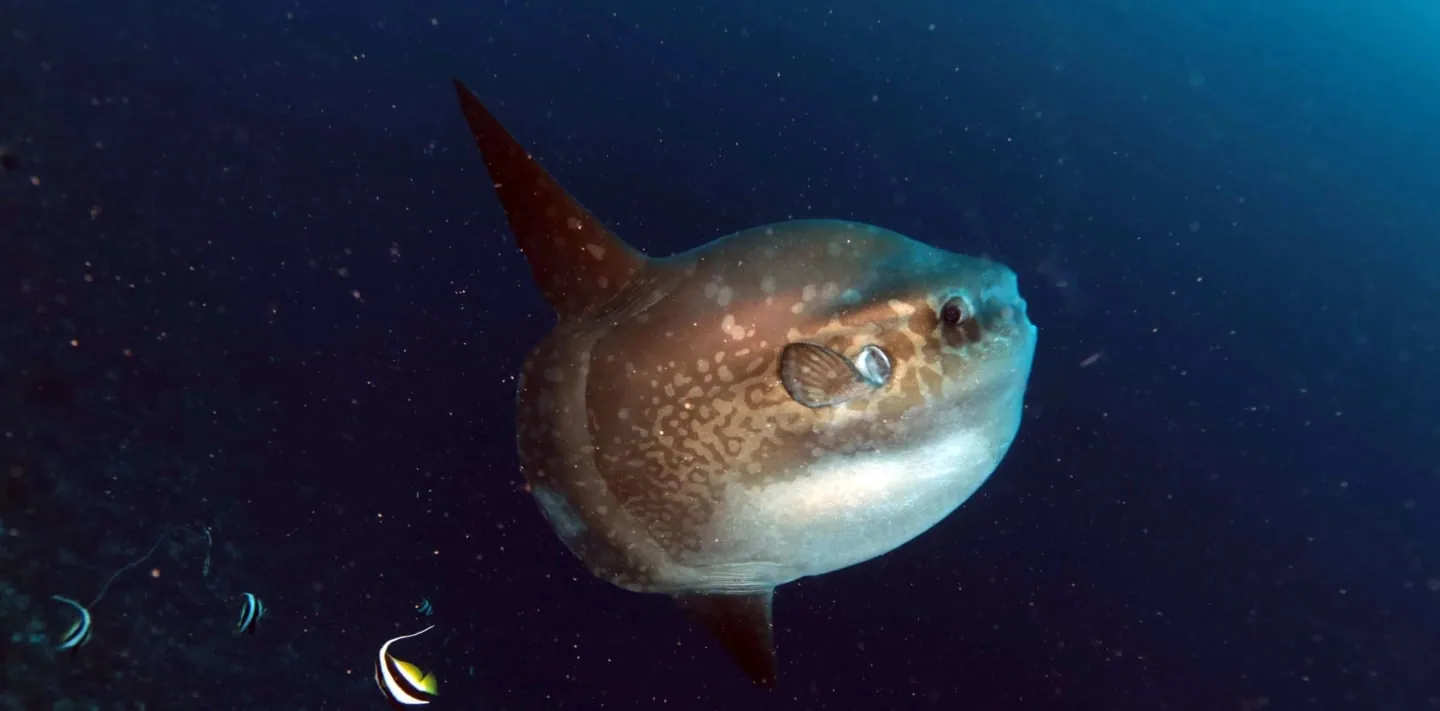
The questions divers ask most about Bali’s giant sunfish, from the best weeks to dive to how close you can get.
A mola mola is a giant ocean sunfish, one of the heaviest bony fish in the world. In Bali, divers can see them from about mid-July to mid-October, when cold water rises around Nusa Penida and Nusa Lembongan and the fish come up to reef cleaning stations. Most encounters happen between 20 and 40 m, in water that can drop to about 16°C.
Outside those months, sightings are rare. Even in season, no dive center can promise a mola on a single dive. Below, we answer the questions we hear most from divers planning a mola trip, using our own notes from diving these waters.
What Is a Mola Mola?
The fish that divers in Bali call mola mola is mostly the bump-head sunfish, Mola alexandrini. Its close relative, the ocean sunfish, Mola mola, is seen here only now and then. Both have a tall, flat, almost round body with long fins above and below, and no real tail.
They are huge. A large adult can be about 4 m tall from fin tip to fin tip and weigh more than 2,000 kg. For most of the year, they live in deep, open water, feeding far below recreational diving depths.
Divers meet them when they rise to the reef to be cleaned. For their life cycle, coloring and how they cope with cold water, learn more on mola mola in Nusa Lembongan.
When Is Mola Mola Season in Bali, Week by Week?
The season is set by the water, not the calendar, so it shifts a little each year. This is the pattern we see around Nusa Penida and Nusa Lembongan:
If you can only choose a few weeks, aim for August or September. They sit in the middle of the season, when the water is usually at its coldest.
Why Do Mola Mola Appear Only in the Cold Months?
From about June to October, seasonal winds push surface water away from the coast south of Bali. Cold, deep water from the Indian Ocean rises to replace it. This is called upwelling.
The upwelling brings the mola’s deep-water world up to the reef. Here is what happens next:
• Cold water reaches diving depth: the reef walls around Nusa Penida are bathed in water that is several degrees colder than the surface.
• Thermoclines form: warm water sits on top of the cold layer, with a sharp line between them.
• Mola rise to be cleaned: the fish come up along the cold water to cleaning stations, where reef fish such as longfin bannerfish and emperor angelfish pick off their parasites.
When the upwelling stops, the cold layer sinks again. The mola stay deep, and sightings drop away.
What Are Your Realistic Chances of Seeing One?
We do not publish a sighting percentage, because one number would mislead you. Your chances depend on several things you can partly control:
• Being there in season: a dive in August gives you a real chance. A dive in March gives you very little.
• Reaching the right depth: most encounters happen between 20 and 40 m.
• Finding the cold water: guides look for the thermocline, because mola tend to appear near it.
• Doing more than one dive: some dives in peak season see several mola, and some see none.
• The tide: the strongest tides, around full and new moon, bring the most water movement, and many divers report more sightings around those dates.
Treat a mola as a highlight, not a guarantee. Plan several mola dives over different days, and enjoy the reef and other life on the dives that miss.
How Deep Do You Need to Go to See a Mola Mola?
Mola sightings in Bali happen mostly between 20 and 40 m. Your certification decides how much of that range you can reach:
Mola do sometimes rise shallower, but you should not plan on it. If seeing one is the main reason for your trip, take the Advanced Open Water course first, and add the Deep Diver specialty if you can.
How Cold Is the Water, and How Do You Stay Warm?
Mola season is the coldest time of year in the water around the islands. The surface may feel fine, and then the temperature drops sharply when you pass through a thermocline. On the deeper reefs, it can fall to about 16°C.
Cold shortens dives and raises your air use, so plan for it before you go:
• Wear enough neoprene: a 5 mm wetsuit is the minimum, and 7 mm with a hood is better if you feel the cold.
• Expect less warmth at depth: a wetsuit compresses as you go deeper, so it keeps you less warm at 30 m than at the surface.
• Watch your air: cold makes you breathe faster, so check your gauge more often.
• End the dive if you shiver: signal your guide, move shallower and surface if you cannot warm up.
Bring a towel, a warm layer and a hot drink for the boat. You will want them between dives.
What Should You Do When You Meet a Mola Mola?
Mola at a cleaning station are easy to scare away, and a frightened mola dives straight back into deep water. Good behavior gives everyone a longer encounter. When you see one, follow these steps:
• Stop and stay calm: signal your buddy and hold your position.
• Keep your distance: stay at least 3 m away, and 10 m if the mola is not being cleaned or is near the reef.
• Approach from the side only: never from behind, above or below.
• Keep your bubbles gentle: never exhale heavily if you are above a mola.
• Stay with your guide: never get closer than your guide does.
• Leave the space open: do not block the mola’s way back to deep water.
A mola left alone often stays at the station for a long time, or comes back after a short swim. Patience usually gives you the best view.
How Do You Plan a Bali Trip Around Mola Season?
A little planning makes a mola trip much more likely to work. Follow these steps:
• Pick your dates: book between mid-July and mid-October, ideally in August or September.
• Get certified to 30 m: take Advanced Open Water before your mola dives, at home or on the island.
• Pack for cold water: bring or rent a thick wetsuit and a hood.
• Book several dive days: spread your mola dives across different days and tides.
• Stay close to the sites: a base on Nusa Lembongan or Nusa Penida means short boat rides and more choice of timing.
Peak season is also the busiest time on the islands. Book your diving and accommodation early.
Frequently Asked Questions
What is a mola mola?
A mola mola is a giant sunfish, one of the heaviest bony fish in the world. In Bali, the species divers usually see is the bump-head sunfish, Mola alexandrini.
When is the best time to see mola mola in Bali?
From mid-July to mid-October. August and September are usually the best months, because they fall in the middle of the cold-water season.
Can you see mola mola in Bali outside the season?
Sometimes, but rarely. A mola can turn up in any month, but without the cold upwelling, they usually stay too deep for divers.
How deep do you need to dive to see a mola mola?
Most sightings happen between 20 and 40 m. Advanced Open Water certification, which takes you to 30 m, gives you a much better chance than Open Water.
How cold is the water in mola season?
It can drop to about 16°C below the thermocline. A 5 mm wetsuit is the minimum, and 7 mm with a hood is more comfortable.
How close can you get to a mola mola?
Stay at least 3 m away, and 10 m when it is not being cleaned. Never approach from behind, above or below, and never get closer than your guide.
Conclusion
A mola mola is a giant sunfish that rises from deep water to Bali’s reefs when the sea turns cold, from about mid-July to mid-October. To meet one, come in August or September, get certified to 30 m, dress for 16°C water and give yourself several dives.
The season follows the cold water, and the mola follow the season. Be in the water when both arrive.
Join our mailing list today
Join our community! Subscribe to our blog for fresh content delivered straight to your inbox
Be part of our community and stay updated with the latest insights! Subscribe to our blog for fresh news, tips, and insights delivered straight to your inbox. Join us on our journey and be the first to know about our updates, events, and special offers. Don’t miss out!